# Get CSV data
import pandas as pd
df = pd.read_csv('https://raw.githubusercontent.com/rfordatascience/tidytuesday/master/data/2024/2024-11-05/democracy_data.csv')

print(f"Dataset shape: {df.shape}")
print(f"Years covered: {df['year'].min()} - {df['year'].max()}")
print(f"Countries: {df['country_code'].nunique()}")
print(f"Democratic classifications: {df['is_democracy'].value_counts()}")Democracy Data Analysis
TidyTuesday Week 45
python
geospatial
altair
geopandas
democracy
Overview
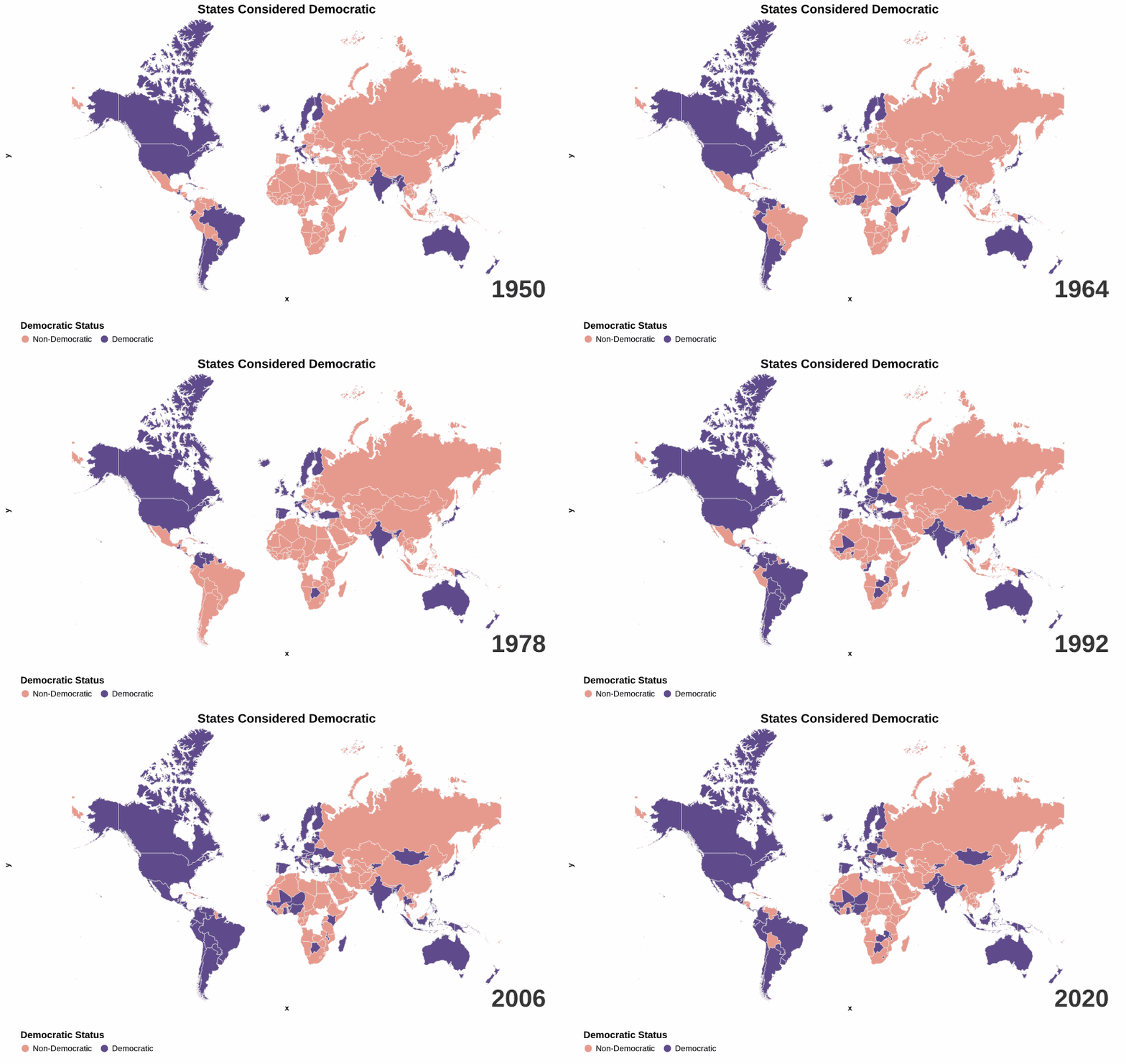
This week’s TidyTuesday focused on democracy data, exploring which countries are considered democratic over time. I created interactive world maps using Python to visualize the evolution of democratic states from 1950 to the present.
Dataset
The dataset contains information about democracy classifications for countries worldwide, spanning from 1950 to recent years. Each country is classified as democratic or non-democratic for each year.
Source: TidyTuesday Democracy Data
Analysis
Libraries Used
pandas- Data manipulation and analysisgeopandas- Geospatial data handling and operationsaltair- Interactive statistical visualizations
Data Loading and Preparation
Geospatial Data Integration
# Get world countries geojson
import geopandas as gpd
world = gpd.read_file('https://datahub.io/core/geo-countries/_r/-/data/countries.geojson')

print(f"World geometries: {len(world)} countries")
print(f"Available columns: {world.columns.tolist()}")
print(f"Sample of country codes: {world['ISO_A3'].head().tolist() if 'ISO_A3' in world.columns else 'ISO_A3 not found'}")
Data Joining Function
# Function that left joins DataFrame and GeoDataFrame
def left_join_gdf(df, gdf, key_df, key_gdf, how='left'):
    """
    Join democracy data with world geometries
    """
    return pd.merge(df, gdf, left_on=key_df, right_on=key_gdf, how=how).set_geometry('geometry')

# Check available country code columns
print("Democracy data country codes sample:", df['country_code'].head().tolist())
print("World data columns:", [col for col in world.columns if 'ISO' in col or 'CODE' in col or col in ['ADMIN', 'NAME']])

# Find the appropriate ISO3 column
iso3_columns = [col for col in world.columns if 'ISO' in col and '3' in col]
print(f"Available ISO3 columns: {iso3_columns}")

# Use the first available ISO3 column
if iso3_columns:
    country_col = iso3_columns[0]  # Should be 'ISO3166-1-Alpha-3'
else:
    # Fallback to first column that might contain country codes
    potential_cols = [col for col in world.columns if any(term in col.upper() for term in ['ISO', 'CODE', 'ADMIN', 'NAME'])]
    country_col = potential_cols[0] if potential_cols else world.columns[0]

print(f"Using column: {country_col}")

# Join democracy data with world geometries
df_shp = left_join_gdf(
    df,
    world,
    key_df='country_code',
    key_gdf=country_col,
    how='left'
)

print(f"Joined dataset shape: {df_shp.shape}")
print(f"Countries with geometry: {df_shp['geometry'].notna().sum()}")
Visualization Setup
import altair as alt

# Color scheme for democracy status
col1 = '#5F4B8BFF'  # Democracy
col2 = '#E69A8DFF'  # Non-democracy
col3 = '#4c4b4c'    # No data

# Focus on a specific year for detailed analysis
year = 2020
df_to_alt = df_shp[df_shp['year'] == year].copy()

print(f"Data for {year}: {len(df_to_alt)} records")
print(f"Democratic countries in {year}: {df_to_alt['is_democracy'].sum()}")
Interactive Map Creation
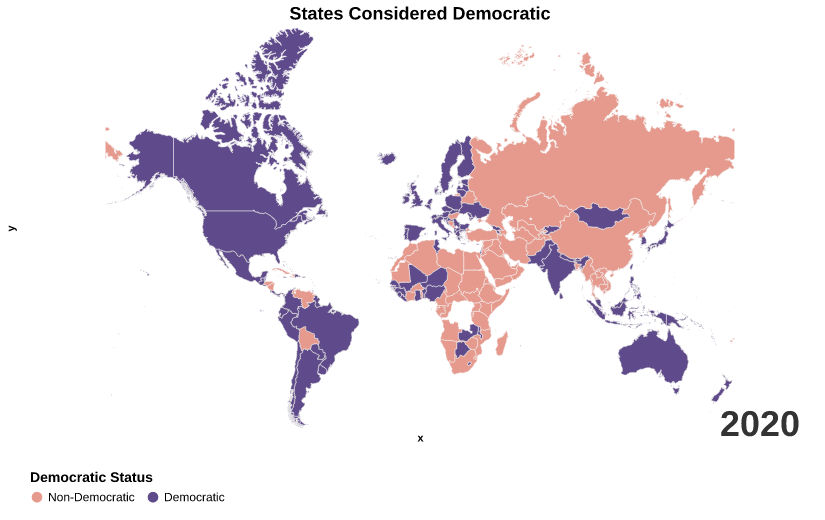
# Note: The 2020 chart will be created as part of the GIF generation
# and saved as week_45.png (the last frame)
Animated GIF Creation
Create individual charts for each year:
import os
import imageio
from PIL import Image
import numpy as np

# Create temporary directory for individual frames inside the current directory
temp_dir = 'temp_frames'
if not os.path.exists(temp_dir):
    os.makedirs(temp_dir)

# Get all available years and sort them
years = sorted(df['year'].unique())
print(f"Creating GIF for years: {years[0]} - {years[-1]} ({len(years)} years)")

# Create individual charts for each year
frame_paths = []
for i, year in enumerate(years):
    print(f"Processing year {year} ({i+1}/{len(years)})")

    # Filter data for current year
    df_year = df_shp[df_shp['year'] == year].copy()

    # Create base map chart
    base_chart = alt.Chart(
        df_year,
        title=alt.Title(
            'States Considered Democratic',
            fontSize=24
        )
    ).mark_geoshape(
        stroke='white',
        strokeWidth=0.5
    ).encode(
        color=alt.Color(
            'is_democracy:N',
            scale=alt.Scale(
                domain=[False, True],
                range=['#E69A8DFF', '#5F4B8BFF']
            ),
            legend=alt.Legend(
                title='Democratic Status',
                labelExpr="datum.value ? 'Democratic' : 'Non-Democratic'",
                direction='horizontal',
                orient='bottom',
                titleFontSize=14,
                labelFontSize=12,
                symbolSize=150,
                padding=10
            )
        ),
        tooltip=[
            alt.Tooltip('ADMIN:N', title='Country'),
            alt.Tooltip('is_democracy:N', title='Democratic'),
            alt.Tooltip('year:O', title='Year')
        ]
    ).properties(
        width=800,
        height=400
    )

    # Create year text overlay
    year_text = alt.Chart(
        alt.InlineData(values=[{'year': str(year), 'x': 780, 'y': 20}])
    ).mark_text(
        align='right',
        baseline='top',
        fontSize=36,
        fontWeight='bold',
        color='#333333'
    ).encode(
        x=alt.X('x:Q', scale=alt.Scale(domain=[0, 800])),
        y=alt.Y('y:Q', scale=alt.Scale(domain=[0, 400])),
        text=alt.Text('year:N')
    )

    # Combine the map and year text, then apply configurations
    year_chart = alt.layer(base_chart, year_text).configure_view(
        strokeWidth=0
    ).configure_axis(
        grid=False
    ).configure_axisX(
        labels=False,
        ticks=False,
        domain=False
    ).configure_axisY(
        labels=False,
        ticks=False,
        domain=False
    )

    # Save individual frame
    frame_path = f'{temp_dir}/frame_{year}.png'
    year_chart.save(frame_path)
    frame_paths.append(frame_path)

    # Save the last frame (most recent year) as the main thumbnail
    if year == years[-1]:
        year_chart.save('week_45.png')
        print(f"Saved {year} chart as week_45.png (thumbnail)")

print(f"Created {len(frame_paths)} frames")
Create GIF from individual frames:
# Create GIF from individual frames
images = []
for frame_path in frame_paths:
    if os.path.exists(frame_path):
        img = Image.open(frame_path)
        images.append(img)

# Save as GIF
gif_path = 'week_45.gif'
if images:
    images[0].save(
        gif_path,
        save_all=True,
        append_images=images[1:],
        duration=500,  # 500ms per frame
        loop=0
    )
    print(f"GIF saved as: {gif_path}")
    print(f"GIF contains {len(images)} frames")
else:
    print("No images found to create GIF")

# Clean up temporary frames
import shutil
if os.path.exists(temp_dir):
    shutil.rmtree(temp_dir)
    print("Cleaned up temporary frames")
Viz
Static Map (2020)
Animated Evolution (1950-2020)